Tuesday, 5 May 2009


ROTHKO

Also refer to Rimbaud poem.

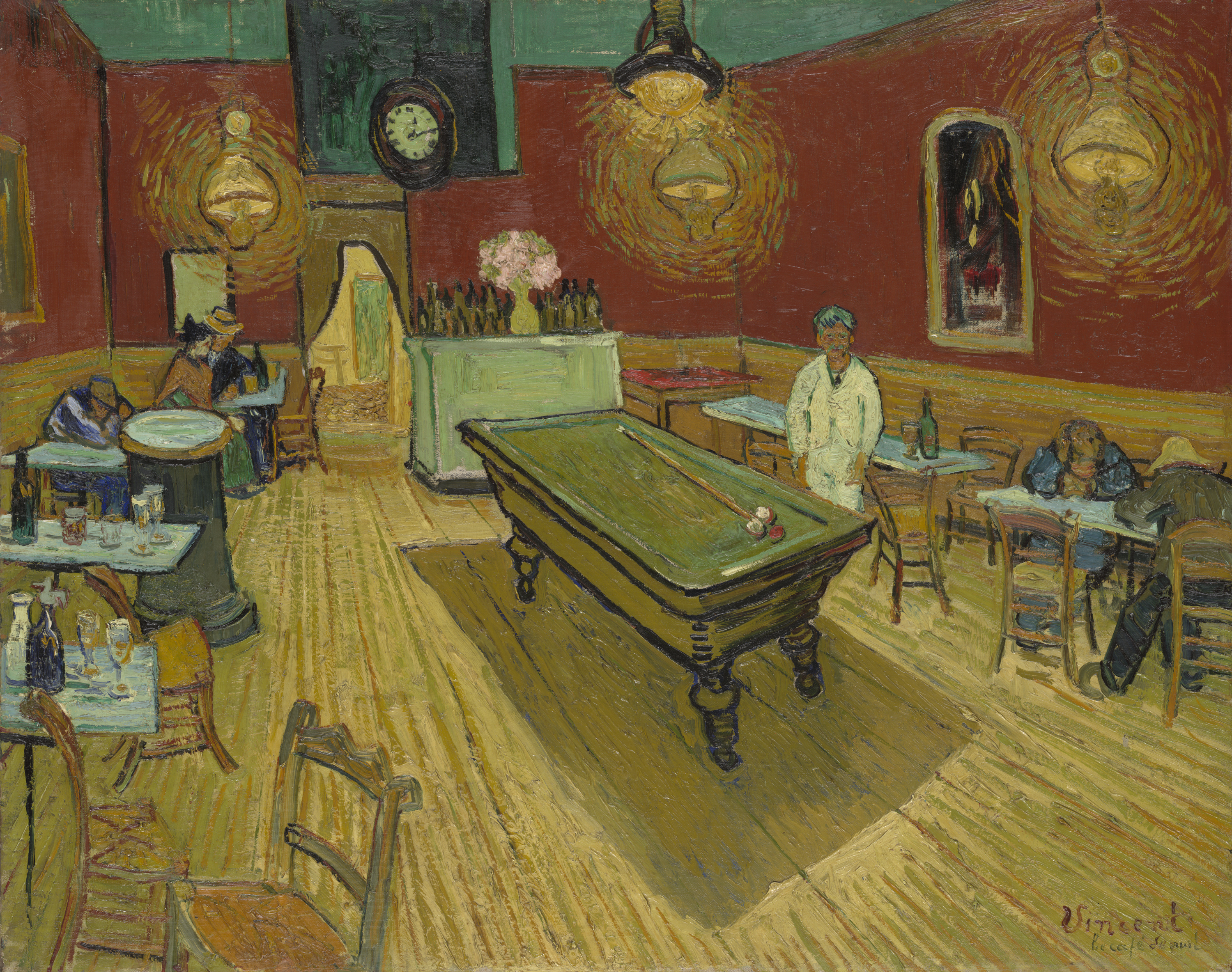
Vincent Van Gogh, The Night Cafe, 1888

My Bohemia: Arthur Rimbaud

I went off with my hands in my torn coat pockets;
My overcoat too was becoming ideal;
I travelled beneath the sky, Muse! and I was your vassal;
Oh dear me! what marvellous loves I dreamed of!

My only pair of breeches had a big whole in them.
– Stargazing Tom Thumb, I sowed rhymes along my way.
My tavern was at the Sign of the Great Bear.
– My stars in the sky rustled softly.

And I listened to them, sitting on the road-sides
On those pleasant September evenings while I felt drops
Of dew on my forehead like vigorous wine;

And while, rhyming among the fantastical shadows,
I plucked like the strings of a lyre the elastics
Of my tattered boots, one foot close to my heart!

Ma Bohème (Fantaisie)
Je m'en allais, les poings dans mes poches crevées ;
Mon paletot aussi devenait idéal ;
J'allais sous le ciel, Muse ! et j'étais ton féal ;
Oh ! là là ! que d'amours splendides j'ai rêvées !

Mon unique culotte avait un large trou.
- Petit-Poucet rêveur, j'égrenais dans ma course
Des rimes. Mon auberge était à la Grande Ourse.
- Mes étoiles au ciel avaient un doux frou-frou

Et je les écoutais, assis au bord des routes,
Ces bons soirs de septembre où je sentais des gouttes
De rosée à mon front, comme un vin de vigueur ;

Où, rimant au milieu des ombres fantastiques,
Comme des lyres, je tirais les élastiques
De mes souliers blessés, un pied près de mon coeur !

Marc Chagall, La Reve, 1939

"Kind Sleep, Free me briefly from myself." (from Masculin/ Feminin by Jean-Luc Godard)

Thursday, 25 December 2008


For one of my classes I had to select a work that had previously been written about, and then write about it myself in one of the styles we had studied. I chose to write an ekphrasis from Henri Matisse's great and honestly rather indescribable 'Red Studio'. Here is the attempt, but please linger more over the image itself than my description.

Matisse’s studio beckons me both to venture further within its warm walls and to retreat, head in hand, for the shame of intruding on such a private space. The master’s wine glass still sits on the table to my left, either the evidence of a pondered brush stroke or the hint of contemplation still to come. A delicately embellished plate lays next to the glass, perhaps evidence of his many travels, but despite its simple, elegant beauty it pales next to the overwhelming canvases hung at different levels around the room and stacked, leaning against the walls as if they were the simple experiments of a child, not the works of a genius. Various artistic implements lie casually around the room, pencils waiting to be seized if inspiration strikes. Off to my right a palette sits with paint drying, perhaps the remnants of one of the many vivid pieces watching over my intrusion. The bright blue daylight is stopped at the window to my left, allowing only a faint green glow, preventing the harsh realities of the outside world from penetrating the warmth of this room, as I have.
I am enticed to move closer to the paintings and sculpture against the back wall, intrigued to discover their colours, their shapes, their lines. But I am unable to move closer to them, afraid that if I come nearer I will be completely unable to resist stretching out a hand to touch the canvas. I am gripped by a fear that the artist himself will enter from behind, angry to find one of his casual viewers has found their way into his sanctuary. But I still can’t force myself to leave this rich interior. Gaining in courage I move from the doorway to a simple wooden chair on my right. My new position both terrifies and emboldens me. I am now on equal level with the objects of Matisse’s studio, no longer looking down. But I am still terrified of being discovered. What would the artist think if he were to find me sitting in this chair where he himself must have deconstructed so many figures to their most pure and vivid colours? But as I lean back into the warm wood, the whole room envelopes me in its rusty, comforting hues. I no longer care if the artist finds me here. In fact, I begin to think he is welcoming me. The grandfather clock on the far wall tells no time, inviting me to stay here in serenity indefinitely. But upon opening my eyes I am again in the doorway, looking down on the scene, longing to be amidst it once more.


This is the first effort I have made on sketches done on my peaceful Christmas Eve in Cromer. The photograph is to give a general idea of the scene that I was drawing from and inspired this particular sketch. 
Beneath is an old photograph of my Opa as a young man in Frankfurt. I have loved this photo for as long as I can remember. I look at it on my wall here in Norwich and it infects me with the same 'wanderlust' as he had, and has. The other picture is my own effort, after this photograph. He is separate from the black and white memory, with colours as vivid and bright as he is in my mind.